
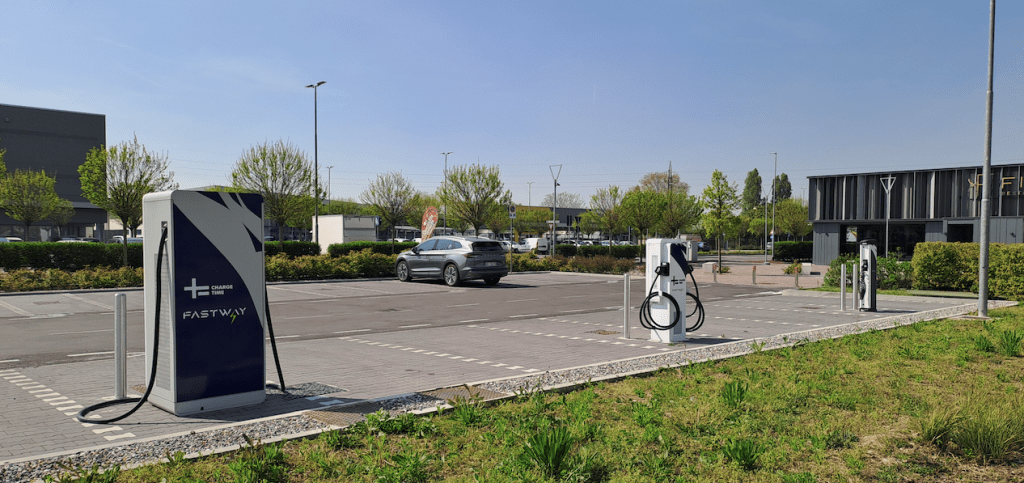
If you manage a large retail store, shopping centre, hotel, or commercial property, the updated Minimum Requirements Decree may apply to you.
The Italian Ministerial Decree of 28 October 2025 on “Minimum Requirements”, published in the Official Gazette on 5 December 2025, sets out the minimum requirements for buildings, including specific obligations for the integration of EV charging infrastructure in buildings with parking spaces, such as supermarkets, shopping centres, retail parks, hotels and corporate premises.
Discover all the benefits of equipping your property with EV charging infrastructure in our in-depth article here!
The Key Point: Chapter 6
Chapter 6 of Annex 1 sets out:
- when the requirements apply (new buildings, major renovations, and existing buildings);
- how many charging points must be installed, based on the number of parking spaces and the type of access (public or private);
- how to properly prepare the infrastructure to facilitate future expansion.
Public vs. Private Car Parks: The Distinction That Makes the Difference
The Decree clearly distinguishes between two types of car parks, applying different requirements to each:
- Public-access car parks: intended for customers of supermarkets, shopping centres, airports, hotels, restaurants and other services, these areas typically have high vehicle turnover and short parking stays, where fast charging is particularly suitable and can be completed while users shop, dine or access the relevant service.
- Private-access car parks: reserved for employees or company fleets. Vehicles typically remain parked for several hours, often throughout the entire working day, making lower-power charging the most practical solution.
This distinction results in different numerical requirements: private car parks are subject to slightly stricter requirements for new buildings, as planning is easier when users are known and usage patterns are predictable.
In both cases, the requirements refer to two types of charging:
- Type A: AC charging point with a rated power of ≥ 7.4 kW and at least 32 A per phase.
- Type B: DC charging point with a rated power of ≥ 50 kW.
Requirements for New Buildings
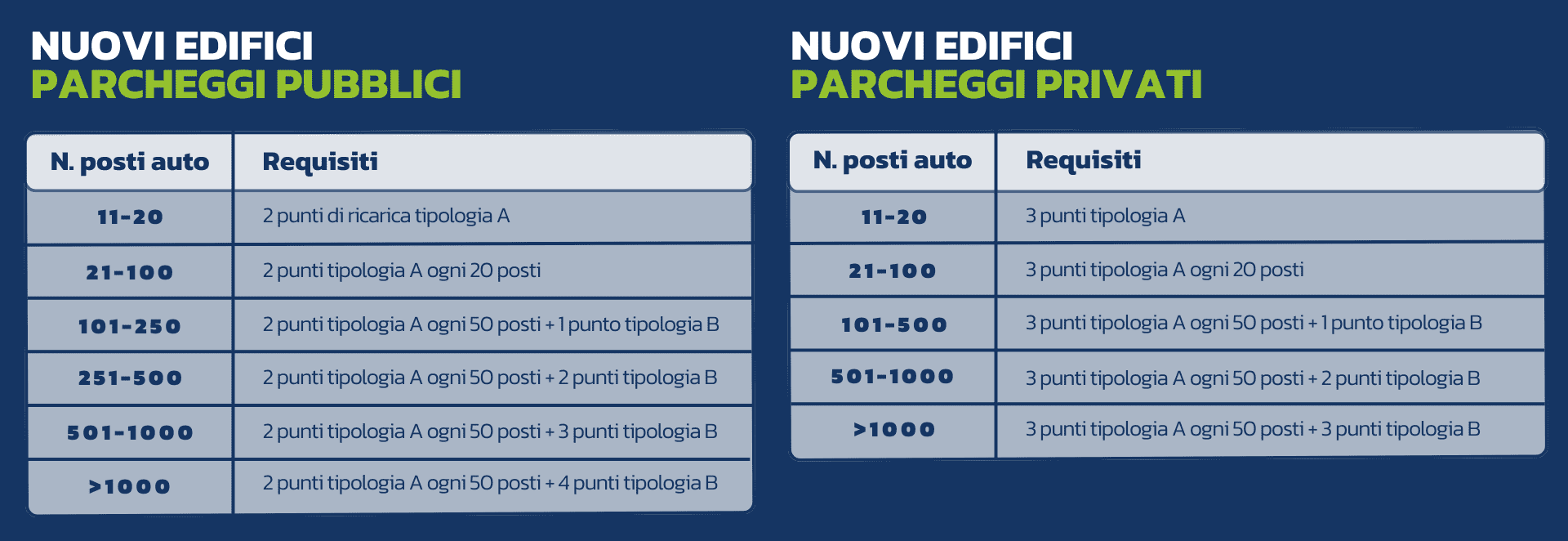
As shown in the table, requirements are higher for private car parks intended for employees or company fleets, as planning is easier in a corporate setting and the investment can be amortised over time.
Pre-installation requirement: For car parks serving non-residential buildings with more than 10 parking spaces, the Decree requires conduit infrastructure to be installed for at least 1 in every 5 parking spaces, using conduits with a minimum diameter of 25 mm for wall-mounted installations and 90 mm for underground installations, making future expansion easier.
Retroactive Requirements for Existing Buildings
The key development concerns existing buildings: for the first time, requirements are introduced even when no renovation work is being carried out.
The quantitative requirements are the same as those for new buildings. The only difference is the applicability threshold: the requirements apply from 21 parking spaces, rather than 11. Below this threshold, no obligations apply.
Deadlines:
- By 1 January 2025: installation of 50% of the required charging points, rounded down.
- By 1 January 2030: installation of 100% of the required charging points.
The Decree enters into force 180 days after its publication in the Official Gazette; the deadlines indicated above are those set out in the regulatory tables and should be interpreted within the specific scope of application established by the Decree.
Major Renovations: When the Requirements Apply
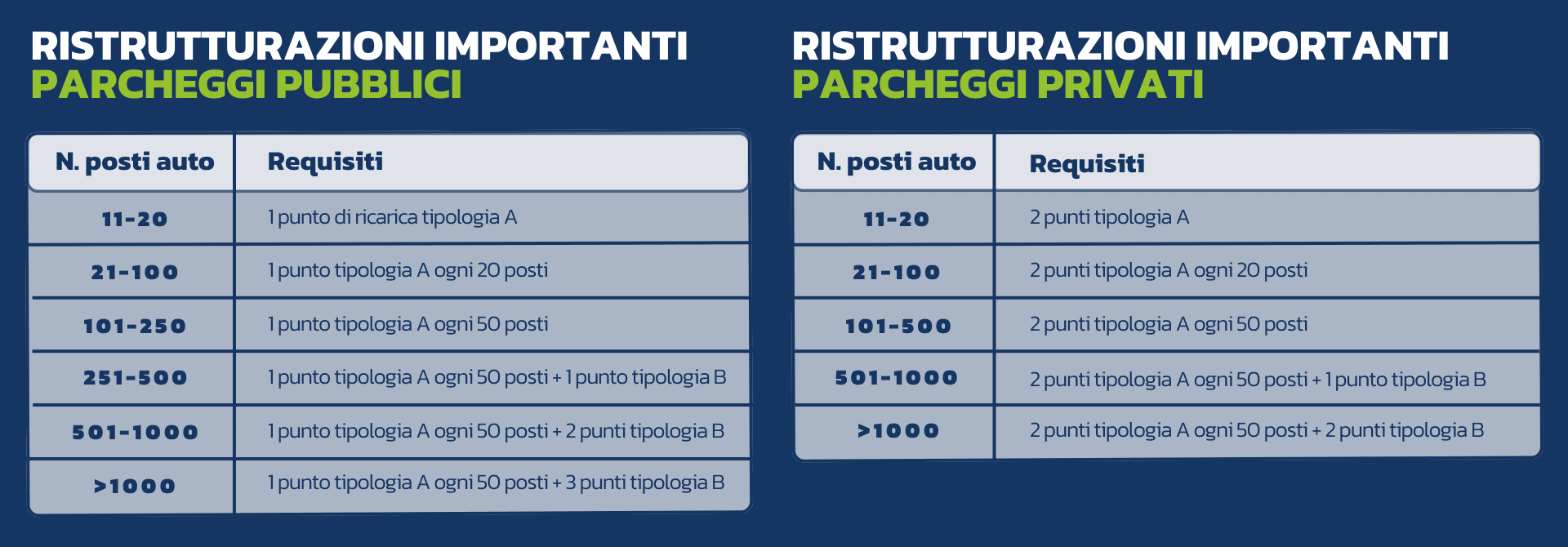
For buildings undergoing major renovations, the requirements apply only if:
- The car park is located within the building, and the renovation works also involve the car park or the building’s electrical infrastructure.
- The car park is adjacent to the building, and the renovation works also involve the car park or its electrical infrastructure.
A renovation involving only commercial interiors or façades, without affecting the car park or electrical systems, does not trigger the requirement.
Useful Flexibility to Optimize Space and Power
The Decree provides for certain equivalencies, allowing for a mix of charging solutions better suited to the specific context:
- 10 Type A charging points = 1 Type B charging system, making it an excellent option for high-turnover locations.
- 1 Type B charging system = 10 Type A charging points (for buildings with private-access car parks only, ideal for slower charging during working hours).
- 2 Type B charging systems = 1 ultra-fast charging system with a power output of 150 kW or more.
- 4 Type B charging systems = 1 ultra-fast charging system with a power output of 350 kW or more.
FastWay by Your Side for Compliance
For retail, real estate and hospitality operators, as well as businesses, this Decree is not just about regulatory compliance: it also affects available power capacity, car park layout, installation feasibility, infrastructure preparation and future scalability.
FastWay supports developers and operators with a comprehensive end-to-end approach: assessment of the specific requirements, identification of the optimal AC/DC charging mix (fast and ultra-fast), infrastructure preparation, installation, operation and maintenance of the charging stations.
If you think your site may be affected by the Decree, or if you want to upgrade your car park’s EV charging offer, contact us at development@fastway.energy for an initial assessment of your site. We can help you navigate the requirements, deadlines and technical solutions best suited to your property.
